

 You’re traveling through another dimension, a dimension not only of sight and sound but of mind; a journey into a wondrous land whose boundaries are that of imagination. That’s the signpost up ahead — your next stop — The Stapankovich Files.
You hear it in the news all the time: the Fed is printing money again. But who gets this cash?
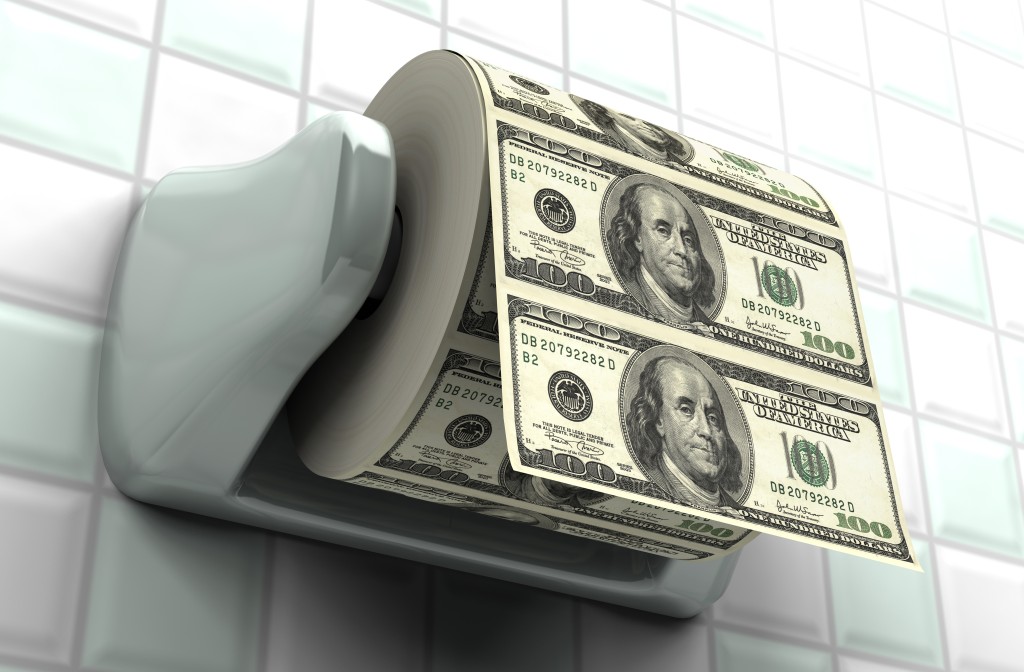
Imagine you had a magic checkbook that you could write checks of any amount to pay for anything, by law everyone had to accept your checks, and there was no “money” in your bank account backing up these checks. You would be the Fed.
The Fed is a quasi-public central bank, whose branches are owned by the member banks. Its seven-member governing board, however, is appointed by the president. But its key decision-making committee has another five members appointed by the branch bank offices — one of which is in Cleveland, so what does that tell you?
The general idea behind the Fed was that if there were a run on the banks — which used to be common — the Fed could step in and lend newly printed money to the banks until the panic passed, and people returned with their deposits. That would prevent scenes like in It’s a Wonderful Life where George Bailey had to calm the panicked mob who all wanted their deposits back at once. He honestly told them: I ain’t got it.
Flash to today, and the Fed is buying $85 billion in mortgages and federal bonds each month. But it’s Mr. Potter who’s getting this cash, and not so much because of a panic — no angry mobs are lining up at banks demanding their cash back — but because he blew the cash making really bad investments, including in derivatives and stocks and all sorts of things that used to send a banker to jail.
Potter is getting magic checks from the Fed, which are literally backed by nothing except the faith of good folk like yourself who may one day want to use some of that new cash to buy a Happy Meal or nice toaster.
If the Fed had purchased Elvis plates or diamonds, well, that wouldn’t help Potter very much. No doubt, it would help somebody raise some cash and unload some merchandise, but it wouldn’t directly help the banks. And make no mistake, the Fed is really all about helping the banks. It is the bankers’ bank. Banks have a special relationship with the Fed, that allows them all sorts of privileges. It’s a club where members get to borrow newly printed money when they’re down on their luck.
Buying stuff that banks are having trouble unloading — like mortgages and government bonds — tends to lift the value of the collateral that they’re holding. By taking the unusual step of buying mortgages, the Fed is helping to keep the price of homes high. It does this so that you don’t have a lot of money at the end of the month after paying for shelter, thereby helping the economy.
Every time home prices drop, the banks edge a little closer to insolvency. That’s when Potter tells his depositors “Sorry, I blew all your cash on building strip-malls in Michigan.” But every time house prices rise, there is a big rush of “profit” from releasing loss reserves, and Potter is pushed wildly around his house in his wheelchair.
So why not have the Fed buy gasoline to artificially raise its price? Or beef? Or steel? That must be good, too, right?
No, that would be too obvious. But when the Fed makes it impossible for some poor schmuck and his wife to buy their first home without paying an arm and a leg, that’s just the system.
But again, don’t get the idea they’re trying to help the current homeowners. It’s all about protecting the banks. If the bank deposits were invested in rolls of steel, it would be the price of steel that the Fed kept high.
When you realize the magnitude of Fed printing, it’s staggering. Right now the Fed is buying $85 billion a month with its magic checkbook. That’s equal to 425,000 mortgage loans of $200,000. Do it in January. Do it again in February. Do it again in March. Do you think that will have an effect on house prices?
What do you suppose would happen to car prices if the Fed for one month turned to buying car-loan paper: They could finance 3.86 million $22,000 car purchases in one month. What if one month they switched to handing out $5 to go on people’s Subway cards to get sandwiches? That would help 17 billion Subway customers, and probably quite a few farmers. Wouldn’t that be good for “the economy”? Answer: No. That would be fucking socialism. Now get the hell out, I’ve got a hooker waiting uptown and I hate when I get stuck in traffic.
The big problem with printing money to buy bonds and mortgages – or anything – is that the money goes leaking into the economy, where it’s used for all sorts of things, like $5 food purchases. And when there’s more money chasing the same amount of goods, prices go up. Long is the list of foolish countries that have played this game, only to watch it end in tears – at some sudden unknown turning point. And yet here we are, playing with matches at the fireworks store, only to help the idiots that got us here from realizing the losses of their recklessness.
If Congress were to vote to raise taxes 3 percent each year, they would get run out of town on a rail, as Potter once said. But when a bunch of unelected Fed bankers just take 3 percent from you by pushing up the cost of Whoppers and gummie bears, the masses just sit there and pick their collective asses, leading me back to the age-old adage: The Masses are Asses.
The reason the masses had to pay this steep tax through inflation is because the bankers didn’t want to take the loss themselves – they wanted to pass it along to the suckers, or “socialize” the loss, as they say. They made a killing on the way up. But when the gains turned to huge losses, they simply passed all the crap that no one any longer wanted to buy to the Fed.
Private profit on the way up — and don’t raise my taxes you blood-sucking government! — and socialized losses on the way down. See how it works?
Why does the government stand for this? Well, the other reason for the “stupidity tax” of inflation is because the government didn’t want to raise taxes in an up-front transparent way, so it just has the Fed buy its debt with its magic checkbook, and pass the bill on to you in the form of inflation. That’s a lot easier than actually raising your taxes, although you probably pay the same either way. Your Big Mac just went up 10 cents (and there was slightly less special sauce).
And when the Fed gets paid back by the government for all the money it borrowed from it, guess what? The Fed has to hand over any interest it earns back to the U.S. Treasury. What a great deal. You lend me money using your magic checkbook, I pay you interest, you hand the interest back to me. And if you do all this, I will grant you the power to print money and do just about anything you want while you serve out your 14-year term of office. Who decided 14 years? The appointment procedures “are designed to minimize the influence of politics,” according to the Fed web site. Yeah, I bet they are. Last time I looked, my city councilman didn’t get to serve for 14 fucking years before we get to decide if he’s an idiot.
If those bills in your wallet are starting to feel a little like Monopoly money, it’s because they are. Try playing Monopoly sometime with a bank that’s printing off new bills that flood the board, and see how long it takes before some joker is trading Baltic Avenue for $800,000.
And shit, for God’s sake, don’t land on Park Place — unless you already own it…
Well done! of course, it does go much deeper, but this is good start down the rabbit hole…lots more of the same though, just that this is now a global phenom, not just in the US